
”Elie Wiesel” Institute`s Journal:
Holocaust. Studii şi cercetări, vol. XVII, No 1 (18)/2025
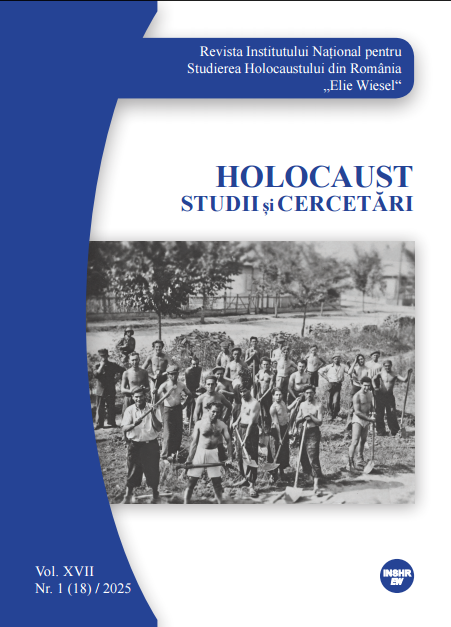
Titlu: Holocaust. Studii şi cercetări, vol. XVII, nr. 1(18)/2025
Preț: 35 lei
Comenzi: office@inshr-ew.ro
List of Authors
Laszlo Alexandru teaches Italian at the National College “George Barițiu” in Cluj-Napoca, Romania. PhD in Romanian literature (1999). He has published studies and polemics on Jewish topics, Romanian literature and writers of the 20th century, medieval Italian literature, and he also wrote Italian-Romanian dictionaries and various translations from Italian and French into Romanian. He was awarded the title of Knight (Cavaliere) of the Order of the Star of Italy, by decree of the President of the Italian Republic, he won the Silver Medal from “Giglio Blu” in Florence, Italy, the Translation Award in Madrid, Spain, the Romanian Writer’s Special Award in Bucharest, etc. His recent books on Romanian literature include: Viață șocantă. Scrieri despre evrei (Shocking Life: Writings about Jews – Israel & Romania, 2021); Cum se inventează un huligan? Mihail Sebastian, ziarist la Cuvîntul (How to Invent a Hooligan? Mihail Sebastian, journalist at Cuvîntul – Moldova & Romania, 2019); Conferințe literare (Literary Conferences – Romania, 2019); Viceversa! Polemici pro și contra lui Paul Goma (Vice versa! Polemics for and against Paul Goma – Romania, 2009), etc. Some of his recent books on Italian literature: A urca la stele. Noi contribuții la studiul lui Dante (Ascending towards Stars. New Contributions to the Study of Dante – Romania, 2023); Lectura lui Dante, 3 vol.: Infernul, Purgatoriul, Paradisul (Dante Readings, 3 vols.: Inferno, Purgatory, Paradise – Moldova, 2020); A revedea stelele. Contribuții la studiul operei lui Dante (To See the Stars Again. Contributions to Dante’s Study – Romania, 2013).
Contact: laszloal@yahoo.it
Ana Bărbulescu is a senior researcher at the “Elie Wiesel” National Institute for the Study of the Holocaust in Romania (EW-INSHR), in Bucharest. Associate professor, University of Bucharest, Department of Jewish Studies. Research interests: the social history of Transnistrian ghettos; forced labor of the Romanian Jews; antisemitism in interwar Romania; Holocaust public memory in post-communist Romania.
Contact: ana.barbulescu@lls.unibuc.ro
Daniel-Valeriu Boboc has been a researcher at the EW-INSHR since 2019. BA in History (1998) and in Political Sciences (2002), MA (1999), and PhD (2012) in Contemporary History at the “Al.I.Cuza” University of Iași. His PhD topic was: Universal Vote and Political Culture in Interwar Romania. He has published articles in several scientific magazines. His research areas include: politics between the two World Wars, Romania in international relations, the Holocaust in Romania, and the history of communism.
Contact: daniel76boboc@yahoo.com
Marius Cazan is a researcher at the EW-INSHR. He received a BA from the University of Bucharest, Department of History, in 2009 and an MA from the same institution in 2011. In June 2015, he defended his PhD thesis:The Dynamics of the Urban Habitat in Bucharest (1948-1989), Constructions, Facilities, Perceptions. He is a member of the research team of the project “Economic Planning, Higher Education, and the Accumulation of Human Capital in Romania during Communism (1948-1989)”, developed at the Center for Administrative, Cultural, and Economic Studies, Department of Administration and Business, and financed by the National Research Council. His research areas of interest are: the Holocaust in Romania, Romanian communism, urban history, the history of Romanian higher education, and the history of everyday life during communism.
Contact: mtcazan@yahoo.com
Ovidiu Creangă, PhD, King’s College London, is a staff Historian and Senior Policy Officer at the Conference on Jewish Material Claims against Germany and the World Jewish Restitution Organization (New York, USA). In this capacity, Dr. Creangă leads efforts to secure remedies for Holocaust survivors worldwide. Previously, he was a researcher at the United States Holocaust Memorial Museum in Washington, D.C., where he documented the fate of Jews, Roma, and other victims of persecution during the Holocaust in Romania. His academic interests and writings cover diverse subjects in Religious Studies, Jewish history, the Holocaust, and reparations.
Contact: ovidiu.creanga@claimscon.org
Nicolae Drăgușin is a scientific researcher III at the “Elie Wiesel” National Institute for the Study of the Holocaust in Romania. Since 2025, he has been an associate lecturer at the University of Bucharest Faculty of Political Science. Since 2022, he has been an EW-INSHR representative to the Romanian delegation to the International Holocaust Remembrance Alliance (IHRA). He holds a PhD in Philosophy (2013, Romanian Academy). He is a PhD student in Political Science (2020-present, University of Bucharest), with a thesis on the political and legal construction of Romanian citizenship (1918-1948). He holds a Master’s degree in Human Rights and Democratization (2008, European Inter-University Centre for Human Rights, Venice) and in Religious Studies – Texts and Traditions (2014, University of Bucharest). He has a BA in Political Science (2008, University of Bucharest), Orthodox Theology (2012, University of Bucharest), and Law (2017, “Nicolae Titulescu” University from Bucharest). He has published extensively in Holocaust. Studii și cercetări, EON, Romanian Review of Political Sciences and International Relations, Studii teologice, Sfera politicii, Revista Polis, Revista de Filosofie, Mediterranean Journal of Human Rights, Review of Ecumenical Studies. He was an invited researcher at the Austrian Academy of Sciences in Vienna (April 2025), Fellow of the Centre for Advanced Study in Sofia (2022-2023), and an “Andrei Scrima” Fellow of the Institut für Ökumenische Forschung in Hermannstadt (2020).
Contact: nicolaedr@yahoo.com
Radu Dumitrescu, MD, PhD, is an Associate Professor at the Department of Social Work, University of Bucharest. His interdisciplinary research integrates qualitative methods with bibliometric analyses, addressing themes such as the vulnerability and resilience of professionals in health and social care, humanism in medical education, and the sociological dimensions of professional ethics. Beyond empirical and bibliometric studies, Dr. Dumitrescu explores the cultural significance of medical and social care practices, analyzing how cultural objects and symbolic representations influence collective understanding and shape the social space of health and assistance. His work also investigates the language of medicine – its ethical, emotional, and social dimensions – and how discourse reflects broader social dynamics. His recent publications include: Loneliness among Physicians: A Narrative and Bibliometric Analysis of an Emerging Public Health Crisis (2025) and The Role of Holocaust — Studii şi cercetări Humanism in Medical Practice and Medical Education: A Narrative Review and Bibliometric Analysis (2025). Through his work, Dumitrescu aims at bridging the gap between the cultural and empirical dimensions of health and social research.
Contact: radu.dumitrescu@medicover.ro.
Bogdan Ionescu is an attorney-at-law and member of the Arad Bar Association, with uninterrupted professional practice since 1 February 2007. He serves as an arbitrator within several Courts of Arbitration and is a certified trainer accredited by the National Qualifications Authority of Romania. He is also the President of the Ethics and Disciplinary Commission of the Romanian Chess Federation. He has published extensively and engaged in scholarly work in legal studies, having authored dozens of articles and monographs. His latest publication is titled Antisemitism and Its Relationship with the Law: The Foundations (Universul Juridic Publishing House, 2024).
Contact: av.bogdanionescu@gmail.com
Daniel Ionuț Irimia is a PhD student in History at the “Alexandru Ioan Cuza” University in Iași and a history teacher at the “Demostene Botez” High School in Trușești. His research interests include the history of the Jewish community in Botoșani, the history of the Jews in Romania, Holocaust memory in contemporary Romania, and the history of right-wing movements. He has published in national and international academic journals and has participated in conferences on Romanian history.
Contact: id.irimia@yahoo.com
Luciana Jinga has been a researcher at the Institute for the Investigation of Communist Crimes and the Memory of the Romanian Exile (IICCMER) in Bucharest since 2007, where she also served as Head of Research and Executive Director. She holds a PhD in History (Université d’Angers, 2011), with a dissertation on women in the Romanian Communist Party. She is an Associate Professor at the University of Bucharest and a close collaborator of NGOs supporting former beneficiaries of the child care system in communist Romania. Her research interests include gender studies, migration, disability history, and the history of medicine. She has coordinated issues of the IICCMER Yearbook, is on the editorial board of History of Communism in Europe, and has published widely, including recent studies on Ana Pauker, humanitarian aid for institutionalized children, and sexology in the communist Romania.
Contact: mia.jinga@gmail.com
Adina Marincea is a researcher at the EW-INSHR and earned a PhD in Communication Studies in 2014. She was a post-doctoral fellow at the New Europe College from 2021 to 2022, where she studied the discursive strategies used by AUR on social media to revive interwar legionary thinking. She has published articles in scientific journals and in mainstream media for the general public. Her areas of interest include the study of right-wing populist and far-right discourse, (neo)fascism, online hate-speech and radicalization, media and political communication.
Contact: adina.marincea@inshr-ew.ro
Florin-Răzvan Mihai is a senior researcher and head of research department at the National Institute for the Study of Totalitarianism (NIST), Bucharest, Romania. Editor-in-Chief of NIST’s Publishing House and publisher-editor of the scientific review Totalitarianism Archives. Coordinator of Corint History Romanian Authors collection. Research interests: history of Ukrainians; politics in interwar Romania; Romania’s international relations during Authors’ Index the Ceaușescu regime. Recent publications: URSS, 1922-1991. Un secol de la constituire, trei decenii de la destrămare. Percepții actuale (The USSR, 1922-1991: A century since Its Creation, Three Decades since Its Dissolution – coordinator, 2023). ORCID: 0000-0002- 7087-7372.
Contact: florin.razvan.mihai@totalitarism.ro
Corneliu-Liviu Popescu is a professor of International, European, and Comparative Law and supervisor of doctoral and post-doctoral research at the Faculty of Law of the University of Bucharest and at the University of Paris 1 Panthéon-Sorbonne College of European Studies. He is also a lawyer registered with the Bucharest and Paris Bar Associations, specialized in cases before the European Court of Human Rights.
Contact: corneliu-liviu.popescu@univ-paris1.fr
Horațiu Suciu is a PhD student at the “Babeș-Bolyai” University in Cluj-Napoca and a history teacher at the “Iulia Hasdeu” Highschool in Lugoj. He has published extensively on the history of Jewish and Roma communities in Romania. He is the coordinator of the annual Restituiri bănățene (Banat Restitutions), published by the Romanian Association for Historical Sciences (vol. I-XII, 2013-2024).
Contact: horatiu77suciu@yahoo.com
Marian Suciu is a Post-doctoral Researcher at the “1 December 1918” University of Alba Iulia, where he is currently researching the Korean trauma in Korean-American literature. He also works as a librarian at a public library. In 2021, he completed his PhD on the image of man in Chinese-American and Korean-American literature. His research interests include Korean-American literature, Korean literature, East-Asian cinema, Far-East history, and Holocaust literature.
Contact: suciu_marian0@yahoo.com
Andrea Tompa is a writer and academic, teaching at the “Babeș-Bolyai” University of Cluj-Napoca, Romania, Faculty of Theater and Film, Hungarian Theater Department. She lives in Budapest, Hungary. Her recent research interest is the representation of the Holocaust in Hungarian literature and Romanian drama. She wrote five novels, her most recent, Often We Don’t Die (2023), dealing with the Holocaust past in Romania.
Contact: andrea.tompa@ubbcluj.ro
Laurențiu Vîju studied at the University of Bucharest, completing his Bachelor’s degree in 2018, followed by a Master’s degree in 2020, both in History, at the History Department of the University of Bucharest. As of 2023, he has been working at the EW-INSHR as a research assistant, planning to continue with a PhD in History.
Contact: laurentiuviju@yahoo.com
Abstracts
HORAȚIU SUCIU
Abstract:
This research paper presents some stereotypes prevalent among the Romanians from Banat during the First World War, based on the written press from the region. The depiction of the Jews was reinforced by the statement that in Banat (then still in Hungary), Jews identified themselves as Hungarians and, as a result, they were the Romanians’ “oppressor enemies”. The paper describes how antisemitism gained new arguments among the Romanians during the world conflagration, once they came into contact with Jews from the East (from today’s Ukraine). After the end of the conflict, with the collapse of the Austro-Hungarian Empire, in the circumstances of the disappearance of any authority, a great many brutalities occurred in Banat against those considered representatives of the Hungarian State. The paper enumerates violent acts directed against the Jewish population.
Keywords: antisemitism, Banat, First World War, Austro-Hungary, antisemitic violence
LASZLO LEXANDRU
Abstract
A young intellectual during the interwar period, Vintilă Horia, placed himself under the protection of an extremist writer, Nichifor Crainic, and had a vast activity of propaganda in the press. He praised Benito Mussolini and Adolf Hitler in glowing terms, glorified the war criminal figure of Ion Antonescu, and justified the massacre of the Jews in the Holocaust. As a reward, he was sent to diplomatic posts in Rome and Vienna. After the war, he took refuge in Argentina and later in Franco’s Spain. In 1960, he was on the verge of winning the Prix Goncourt in Paris, for his novel God was Born in Exile. His past was revealed, and he was never awarded the prize. Since then, many Romanian intellectuals have argued in favor of Vintilă Horia, in an attempt to strategically regain a cultural agent who had affirmed himself overseas, by omitting, hiding, or even contesting his ferocious extremist past. This scientific study reviews the most acute and tension-filled moments of a debate to which many contributed with cunning participation and in bad faith.
Keywords: propaganda, interwar press, Hitlerism, fascism, Vintilă Horia, intellectuals
DANIEL BOBOC
Abstract
Antisemitic leaders played various roles during their visits to nazi Germany. Primarily, their purposes were propaganda-related. The German newspapers of the time fabricated convincing biographies to prove to the public that they were important figures who shared the nazi ideology. The texts they constructed focused on the typical themes and narratives of the nazis: the unity of the people, their trust in Adolf Hitler, the need for racial purity, and the fight against the enemy, both inside the country and abroad. The Romanian leaders also played the role of “useful idiots”, by distorting the reality of the concentration camps. The situation was the same in other directions, too. The Germans needed people to support their economic and political interests in Romania, and chose them to do this. Adolf Hitler usually worked with the staff of the German Ministry of Foreign affairs, with whom he had built his diplomatic efforts, but he also encouraged people placed in ideological organizations to get involved. Their organizations did not come up with very coherent plans, which caused a lot of discontent. They were also quite incompetent. Hitler’s Ministry and project for Romania aimed for the two states to develop economic relations and have the Romanians’ ties with France cut through in the process. The ideological organizations were given a lot of media coverage, but little practical support.
Keywords: nazi organizations, international relations, Romanian interwar antisemitism, Romanian antisemitic elites, German antisemitic newspapers.
NICOLAE DRĂGUȘIN
Abstract
The paper aims at analyzing how Dumitru Stăniloae, a priest within the Romanian orthodox church and a theologian, analyzed the concepts of nation, nationalism, and ethnical minorities in his articles published in the newspaper Telegraful român. It shows that Stăniloae first elaborated a theory of the (ethnic) nation and subsequently one of religious nationalism. Within this framework, he spoke about the ethnical minorities and precisely about the Jews.
His vocabulary and arguments rhymed in many respects with the discourse of the Romanian far-right. This coherent view of nation and nationalism, however, seemed to have been challenged, starting from 1940, by a theory of Christian anthropology infused with Christian existentialism and Martin Buber’s dialogical philosophy. Therefore, one might identify two images of Stăniloae between the theologian of Christian anthropology and the theoretician
of ethnical nation(alism).
Keywords: nation, nationalism, minorities, Romanian Jews, antisemitism, Romanian orthodox church, Dumitru Stăniloae
LUCIANA JINGA
Abstract
This chapter analyzes the Romanian branches of the Women’s antifascist Front between 1934 and 1938, focusing on three organizations: the Women’s antifascist committee, the Society for the Protection of Mothers and children, and the Women’s Front. Based on archival surveillance files of the Siguranță, press coverage, and international documentation, the study shows that these organizations became prime targets of both state repression and the antisemitic discourse. The Women’s antifascist committee was outlawed in 1934; the Society for the Protection of Mothers and children was dissolved after its members got arrested during the “Milk Week” protest in 1935; and the Women’s Front, despite its broad appeal and participation in international peace campaigns, was dismantled in 1938. The press played a crucial role in conflating communism with the Jewish identity, exemplified by the trials of ana Pauker and others. The chapter highlights how gender, repression, and antisemitism intersected in interwar Romania.
Keywords: antifascism, repression, antisemitism, propaganda, gender
ANDREA TOMPA
Abstract
More than one hundred documents are preserved in Jenő Janovics’ archive in Cluj-Napoca, documenting his efforts to obtain exemption from the so-called Jewish Laws. As a former theater director and prominent Hungarian intellectual, he was required to prove that he had been a “good and faithful Hungarian” in Romania after 1919. Though he never identified himself as a Jew, Janovics pursued exemption in order to secure himself a public role after the Second Vienna Award. This study examines the correspondence between Janovics and the Hungarian authorities and traces the increasingly limited opportunities available to him.
Keywords: Jenő Janovics, Holocaust, Cluj, National Theater, Hungarian Theater
ANA BĂRBULESCU
Abstract
The paper proposes a local approach to the Holocaust in Transnistria, following Tim Cole’s theoretical approach regarding a non-monolithic telling of the events, with an emphasis on aspects related to local contexts. Theoretically, the same legal provisions generally shaped the anti-Jewish policies of the Romanian authorities in Transnistria from early autumn 1941 to mid-March 1944. However, in practice, substantial differences – often caused by local factors – determined the difference between life and death. Following this argumentative line, the present paper focuses on the Jews ghettoized in Tulchin County, trying to untangle the different imprisonment scenarios experienced by those ghettoized there.
Keywords: Transnistria, Tulchin, camps, ghettos.
OVIDIU CREANGĂ
Abstract
The Antonescu regime systematically persecuted Christian religious minorities, compelling many to abandon their faith and (re)join the Romanian Orthodox Church to avoid arrest, imprisonment, or deportation to Transnistria. This campaign, supported by the Romanian Orthodox Church, aligned with the regime’s ultranationalist objective of population homogenization. While recent scholarship has begun to address the experiences of religious minorities under Antonescu, a localized and comparative approach remains to be made. This article examines the regime’s actions against Baptists and Molokans in Cetatea Albă, southern Bessarabia, using newly available archival sources to illustrate efforts to eliminate these groups and their resistance under duress. The regime’s homogenization efforts were particularly aggressive in border regions, where religious and ethnic diversity posed a challenge to its ideological vision.
Keywords: Ion Antonescu, religious persecution, Christian minorities, Baptists, Molokans, population homogenization.
MARIUS CAZAN
Abstract
This study examines the role of the Romanian press during 1940 and 1941 in consolidating the myth of Judeo-Bolshevism. I use the contents of the Universal daily newspaper and the Sentinel magazine, these being publications with different editorial profiles and audiences. The analysis has shown that the articles, reports, and entertainment materials were not mere accounts, but active instruments of propaganda meant to present the Jewish community as a collective enemy and justify its marginalization and the acts of violence it was submitted to. In the pages of the two publications, military and political conflicts were presented as a “crusade” against the Jewish influence, while Bolshevism was constantly associated with the “Jewish danger”. Beyond those publications, in which antisemitism was a central editorial focus, this article aims at analyzing the content of important publications of the time, which were not at the forefront of antisemitic militancy, thus attempting to recover the centrist ideas of the official propaganda in the analyzed period.
Keywords: Sentinela; Universul; antisemitic propaganda; crusade against Bolshevism.
DANIEL IONUȚ IRIMIA
Abstract
The Jewish community of Botoșani played a particularly significant role in both local and national history. With an uninterrupted presence spanning nearly three centuries, its communal institutions actively contributed to the economic and social development of the city and the surrounding region. The Holocaust period severely disrupted communal life, while the transition to the communist regime brought additional challenges. From 1945 to 1949,
the community leadership sought to restore the interwar dynamism; however, the prevailing political and social conditions imposed numerous constraints. The Jews who remained after the war, deeply affected by trauma and loss, faced acute material and psychological needs. In this context, the international Jewish relief organizations provided substantial assistance, supporting the upkeep of schools, hospitals, and synagogues, thereby ensuring the community’s survival. At the same time, the communist authorities aimed at subordinating the community through newly created organizational structures, carrying further the control mechanisms previously established under the Antonescu regime. Consequently, the Jews of Botoșani, still under the shadow of the Holocaust, were compelled to adapt to a new political ideology that instrumentalized their collective experience. This study examines this complex process, emphasizing both the community’s postwar reconstruction efforts and the strategies employed by the communist regime to integrate and control the Jewish population.
Keywords: Israelite community, Botoșani, education, Jewish Democratic Committee.
RADU DUMITRESCU
Abstract
This study proposes an innovative hermeneutic approach to the representation of the Holocaust in contemporary Romanian cinema, using Aaron T. Beck’s cognitive triad – thought, emotion, behavior – as an interpretative model transposed into an integrative analytical grid: ideational, affective-aesthetic, and contextual-pragmatic. in a context marked by the delay in coming to terms with the traumatic past and the absence of an institutionalized memory, recent Romanian films about the holocaust become instruments of identity interrogation, ethical pedagogy, and visual counter-memory. The paper analyzes a corpus of films (documentaries and essay fictions) that problematize collective trauma, historical marginalization, and the role of cinema as a space of symbolic reparation. The aesthetics of retention, silence, and fragmentary poetics is put in dialogue with theories of cultural memory, post-memory, and the visual representation of trauma, offering a reflexive, transdisciplinary theoretical framework. Film thus becomes not only an indirect witness of the past, but also a critical actor of the present, capable to restore the visibility of ignored suffering and challenge the collective conscience. The article argues for the recognition of cinema as a legitimate form of active memory and for the need of strategic alliances between artistic creation, humanistic research, and public institutions, with a view to a democratic culture of historical assumption.
Keywords: The Holocaust in Romanian film, cultural memory, post memory, Beck’s cognitive triad, visual representation of trauma, essayistic cinema, visual pedagogy, historical marginalization, biopolitics, aesthetics of silence, cinema of memory, ethical responsibility, hermeneutic interdisciplinarity.
FLORIN-RĂZVAN MIHAI
Abstract
The massacre at Babyn Yar is part of the phenomenon known as the “holocaust by bullets”, a term inspired by the title of Father Patrick Desbois’ book. A first positive step has indeed been taken, considering that the memorialization of the holocaust functions as a litmus test revealing the degree of democratization within a society. Ukraine’s capacity to acknowledge and commemorate the crimes committed against the Jewish population demonstrates her attachment to European values and her commitment to the principles underlying the Western pattern of civilization. Yet the problems remain open – especially in the context of the war that began in 2022. Will the memorialization of the Jewish population’s painful past continue to be a priority for the Ukrainian state, once the war is over?
Keywords: memorialization; Ukraine; Babyn Yar; holocaust; sites of memory.
MARIAN SUCIU
Abstract
In Romania, during the last three decades, there have been prominent people who denied or minimized the existence of the Holocaust, in general, or its occurrence in Romania, which has influenced the perception of the general population. Therefore, in addition to passing legislative measures to combat the spreading of historical misinformation, the authorities initially introduced an optional subject on the Holocaust in schools. This was recently made mandatory, its scope being to prepare future generations to confront any disinformation regarding this event. Yet, the introduction of a history of the Holocaust wherein teachers explain theoretically the events and assign as homework readings from autobiographical journals and novels will not suffice, as the current young generations need modern ways of teaching that introduce graphic novels and comics into the classrooms. Furthermore, the mandatory History of the Holocaust should be supplemented with events set up for presentations of additional researchers and papers, and librarian-led educational programs on the Holocaust based on picture books and graphic novels dedicated to primary-school and high-school students. After a preliminary presentation of the context for introducing the History of the Holocaust as a subject in the Romanian school curriculum, this paper underlines the importance of multi-modal books in teaching, in general, and in Holocaust education, specifically. The research will not only emphasize why teachers and librarians should use multimodal books in their teaching but also explain how they can integrate these books into their activities by offering examples of such integration.
Keywords: graphic novels, Holocaust education, library programs, picture books.
BOGDAN IONESCU
Abstract
Our profession as a lawyer – perhaps inevitably – predisposes us to be a predominantly practical person. Indeed, when an act (of antisemitism – let us label it as such from the outset) enters the legal “arena”, into the machinery of the justice system, it requires above all a concrete and effective approach, rather than a purely theoretical or illusory one. criminal investigation bodies, prosecutors, and judges (whether in criminal or civil matters) are themselves practical individuals, oriented towards the concreteness of things. Let there be no misunderstanding: every actor in the legal field must acquire a solid theoretical foundation in order to practice. Theory must intertwine with practice, they must harmonize, and support each other. However, there are domains of knowledge (which include antisemitism) that require the absorption of exceptionally broad theoretical insights in order to be properly understood. Let us state it plainly: antisemitism is a highly specialized field, and with only the rarest exceptions, the level of knowledge of those called to adjudicate legal cases involving antisemitism is extremely limited, elementary at best. This article does not aim at offending or blaming anyone. Its role is to present matters as they truly are, at the “grassroots” level, to explain the causes of this factual situation, and, not least, to propose concrete solutions. Legal, practical, and accessible solutions so that the act of justice may respond in a far more professional and effective manner to the profoundly alarming resurgence of antisemitism in our time.
Keywords: antisemitism, hate speech, law, cultural expertise, expert witnesses.
CORNELIU-LIVIU POPESCU
Abstract
The European Court of Human rights ruled, in its 2024 judgment in the case of Zăicescu and Fălticineanu v. Romania, that the acquittal, in the late 1990s, of two senior Romanian military intelligence officers, convicted after the end of the Second World War for crimes against humanity and war crimes, consisting in planning, organizing, and carrying out massacres and deportations of Romanian Jews, without any reasonable grounds, in a discreet judicial proceeding and with a motivation contrary to International Humanitarian Law and International Criminal Law, as well as to scientifically proven historical facts, represented a form of Holocaust denial and distortion, which resulted in the violation of the right to privacy in conjunction with the right to non-discrimination of Jewish Holocaust survivors and victims of the criminal acts in question. While previous european case law has dealt with Holocaust denial by individuals, and therefore the positive obligation of States to protect the right to privacy and non-discrimination of Holocaust survivors, while maintaining a fair balance with the freedom of expression of third parties, where the failures of States were indirect, passive denial, this european judgment constitutes a significant development by sanctioning direct state denial of the Holocaust.
Keywords: Holocaust, Holocaust denial, private life, discrimination.
ADINA MARINCEA
Abstract
This paper analyzes the common ground and disagreements between the three definitions of antisemitism (IHRA, NEXUS, JDA) and elaborates a practical guideline for distinguishing between antisemitic and non-antisemitic references to Israel and Zionism. It then applies this guideline to three random samples of articles, posts, and comments, totalling 10% items out of 8,061 Romanian-language online messages containing the word ‘Zionist’, published from March 2023 to March 2024. The findings show that up to 85% of the Romanian comments and 60% of the posts and tweets use the term ‘Zionist’ in antisemitic contexts. The format and source of the message matters, antisemitic meanings being much less present in web articles (14.9%). The non-antisemitic annotated content is divided in messages that are critical or neutral towards Zionism or Israel, on the one hand, and those that are positive, critical towards anti-Zionism or even fall into other forms of racial prejudice – most commonly targeting Palestinians. Each category is exemplified in the qualitative analysis that explains how the assessments were made in the annotation process. While results show that anti-Zionism and political criticism of Israel should not be conflated with antisemitism, they also confirm the findings from other countries that online commentary overwhelmingly uses the term ‘Zionist’ as a stand-in for ‘Jew’, associated with classical antisemitic stereotypes. This should caution the use of terms like ‘Zionist’ and ‘anti-Zionist’.
Keywords: Zionism, anti-Zionism, antisemitism, Israel, content moderation.
LAURENȚIU VÎJU
Introduction of the book review:
This book by Marta Caraion, Transnistria. The History of a Family between East and West, 1941-1981, came out at Polirom in 2025. Initially published in France by Librairie Arthème Fayard in 2024, the book was translated into Romanian by Nicolae Constantinescu.
The author is a Professor of French Literature at the University of Lausanne, in Switzerland. It chronicles the lives of her mother and grandmother, along with the traumatizing experiences they shared as they were deported to Transnistria and survived, unlike Caraion’s grandfather, who was also deported, but died there. The volume begins with a brief summary of her mother’s, grandmother’s, and grandfather’s lives up to 1944, highlighting their multiple (self-imposed) exiles and, most importantly, their deportation to Transnistria. Marta Caraion notes that her mother had been waiting over forty years to tell this story.
The author approaches the story in chronological order. In the first two chapters, Caraion explains what the book is about and its subject-matter. Starting from an interview her mother gave in Romanian about her experience, the author decided to write this book in French, to distance herself from the source-material and adopt a more impartial stance. Marta Caraion includes a QR code that redirects the readers to her mother’s interview.